# Introduction
> Learn about fast-url – a high-performance URL building library that makes constructing URLs safe and convenient
**fast-url** is a lightweight, high-performance JavaScript/TypeScript library for building URLs safely and conveniently. It's a modern fork of [urlcat](https://github.com/balazsbotond/urlcat) with a strong focus on performance optimization and code simplicity. Measured numbers against urlcat are on the [benchmarks](/fast-url/benchmarks) page.
**Why fast-url?**
Building URLs manually is error-prone and tedious. fast-url handles parameter
escaping, proper URL segment joining, and clean separation of path and query
parameters automatically.
## Why This Fork Was Created
The original [urlcat](https://github.com/balazsbotond/urlcat) library is a solid foundation for URL building, but over time it has faced several challenges:
### Problems with the Original Project
- **🐌 Performance bottlenecks**: The original implementation wasn't optimized for high-throughput scenarios
- **📦 Outdated dependencies**: Not regularly updated with the latest Node.js optimizations
- **🔧 Maintenance gaps**: Infrequent updates and slower adoption of modern JavaScript features
- **⚡ Query string encoding**: Used older, less efficient encoding methods
### How fast-url Addresses These Issues
**fast-url** was created to solve these problems while maintaining compatibility:
1. **Performance-first approach**:
- Optimized query string encoding matching Node.js performance
- Reduced function call overhead
- Direct constant access for better V8 JIT optimization
- 5-20% faster than previous implementations in many scenarios
2. **Regular maintenance**:
- Active development and quick bug fixes
- Regular dependency updates
- Modern TypeScript implementation
3. **Simplified codebase**:
- Minimal dependencies (only fast-querystring)
- Clean, maintainable code
- Focus on core functionality
4. **Production-ready**:
- Comprehensive test coverage
- Battle-tested in real-world applications
- Performance benchmarks with CodSpeed integration
## Key Features
Only one dependency (fast-querystring) with minimal bundle size - perfect
for performance-critical applications
Written in TypeScript with full type definitions for better development
experience and compile-time safety
Automatically escapes parameters and handles edge cases - no more broken
URLs from special characters
Uses `codePointAt` for proper Unicode handling, including graceful encoding
of lone surrogates and emojis
Multiple ways to build URLs for different use cases - from simple
concatenation to complex path and query parameters
Optimized for speed with benchmarks showing significant improvements over
the original implementation
## The Problem
Building URLs manually is error-prone and difficult to maintain:
```javascript
// ❌ Error-prone manual approach
const url = `${baseUrl}/users/${id}/posts?limit=${limit}&offset=${offset}`;
await fetch(url);
```
**Issues with manual URL building:**
- 🔴 Double slashes when joining paths
- 🔴 Unescaped parameters breaking URLs
- 🔴 Complex string concatenation logic
- 🔴 No validation of parameter types
- 🔴 Difficult to maintain and read
## The Solution
fast-url provides a clean, safe API for URL construction:
```javascript
// ✅ Clean and safe with fast-url
import { createUrl } from 'fast-url';
const url = createUrl(baseUrl, '/users/:id/posts', { id, limit, offset });
await fetch(url);
```
**Benefits:**
- ✅ Automatic parameter escaping
- ✅ Proper URL segment joining
- ✅ Clean separation of path and query parameters
- ✅ Type checking for path parameters
- ✅ Easy to read and maintain
**Performance Matters**
In performance benchmarks, fast-url matches or exceeds the original urlcat
implementation while providing additional safety features and better Unicode
handling.
## Visual Example
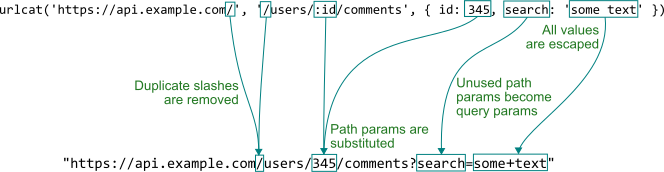
Here's a visual representation of how fast-url simplifies URL building:
## When to Use fast-url
fast-url is ideal for:
- 🌐 **REST API clients**: Building dynamic API endpoints
- 🔗 **URL generators**: Creating shareable links with query parameters
- 📱 **Single-page applications**: Managing client-side routing and navigation
- 🛠️ **Backend services**: Constructing URLs for external API calls
- 📊 **Analytics tracking**: Building tracking URLs with parameters
## Quick Example
Here's a real-world example showing how fast-url simplifies URL building:
```typescript
import { createUrl } from 'fast-url';
class UserAPI {
private baseUrl = 'https://api.example.com';
getUserPosts(userId: number, page = 1, limit = 10) {
return fetch(
createUrl(this.baseUrl, '/users/:userId/posts', {
userId,
page,
limit,
sort: 'created_at'
})
);
}
}
// Generated URL:
// https://api.example.com/users/42/posts?page=1&limit=10&sort=created_at
```
```typescript
class UserAPI {
private baseUrl = 'https://api.example.com';
getUserPosts(userId: number, page = 1, limit = 10) {
// Remove trailing slash from baseUrl if present
const base = this.baseUrl.endsWith('/')
? this.baseUrl.slice(0, -1)
: this.baseUrl;
// Build path with encoded userId
const path = `/users/${encodeURIComponent(userId)}/posts`;
// Build query string
const params = new URLSearchParams({
page: String(page),
limit: String(limit),
sort: 'created_at'
});
return fetch(`${base}${path}?${params.toString()}`);
}
}
```